
AfroLatinx History and Contributions Matter
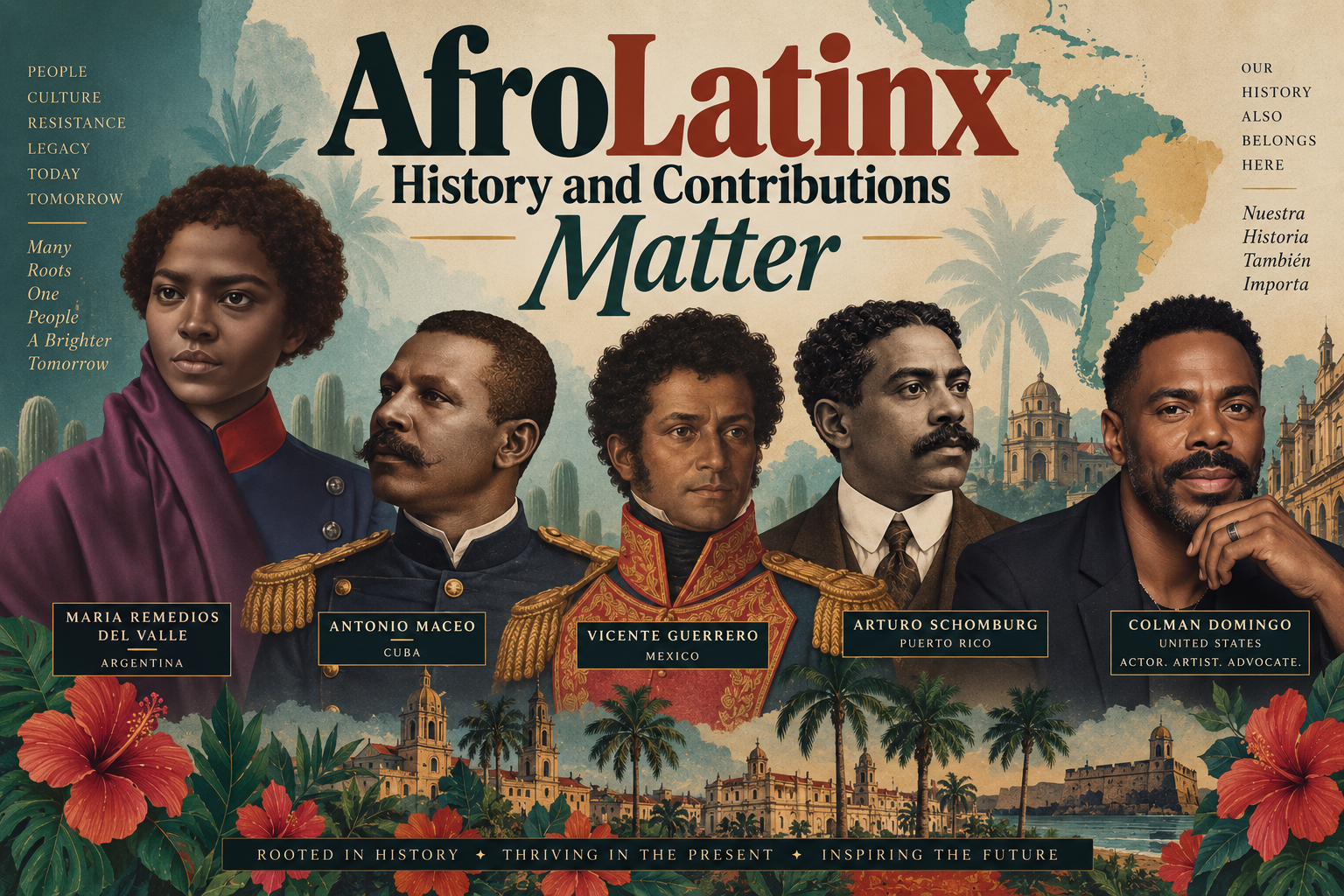
Image submitted by the author
by Janiah Hinds
Amara La Negra, a singer, dancer, author, and television host best known for her appearance on the reality TV show Love and Hip Hop: Miami, has openly discussed the challenges she has faced identifying as both Black and Latina. Other Afro-Latina celebrities share the same experience. Cardi B, a Grammy Award-winning rapper, stated, “I expect people to understand that just because we're not African-American, we are still [B]lack. It's still in our culture... I hate when people try to take my roots from me. Because we know that there’s African roots inside of us.” Amara La Negra and Cardi B are both Afro-Latinas with roots in the Dominican Republic. The feelings expressed in these quotes are shared not only by these two influential figures but also by many members of the Afro-Latinx community. These two women have often spoken about the pride they take in being Afro-Latina and recognize that one can be both Black and Latinx simultaneously. Amara La Negra has also discussed the struggles of being Afro-Latinx in entertainment due to the lack of representation in the Latin American industry. The average portrayal of a Latinx person on Spanish-language television networks such as Telemundo is often lighter-skinned or European-presenting with blue eyes. This portrays a false narrative of the population of Latin America, and these two women hope to serve as role models and examples, bringing awareness to the diversity and the people of African descent living there.
This lack of representation is not a recent problem. Afro-Latinx people have been left out of conversations and even history in Latin America for centuries. A great majority of enslaved Africans taken from their homeland were brought to Latin America via the Transatlantic Slave Trade. Therefore, it is impossible to deny that those of African descent were present during the fight for independence and the founding of countries. It’s not that Afro-Latinx people have contributed nothing, but they were often pushed to the side or left out of history due to their skin color. Much of Latin America’s history is told from a European perspective, leaving the contributions and presence of the Black community largely absent. Those of African descent served as soldiers, generals, and strategists during the fight for independence, and after gaining their independence, many of these heroes’ stories were erased or forgotten. This erasure can be linked to the philosophy of "blanqueamiento” or “whitening,” which favored European ideals and identity while decreasing the visibility of those of African identity. As a result, the efforts of people of African descent were excluded from Latin American history. Some countries, such as Brazil, have made great strides in acknowledging the contributions and history of those of African descent. Other countries, such as Argentina, have posed themselves as “white” countries, denying their black citizens and history.
While many of their names have not been promoted or remembered by the general public, Black men and women have played key roles in shaping Latin America. Many have been leaders of independence movements, helped establish communities, and made sacrifices, but have not received the attention they deserve. One of those heroes, Antonio Maceo, also known as the Bronze Titan, was a figure central to Cuba’s independence from Spain. Maceo was an Afro-Cuban general known for his bravery and leadership. He started as a private and later rose in the ranks to a general in the army. He was also an abolitionist who made the abolition of slavery a priority in his fight for Cuban independence. Similarly, another often overlooked Afro-Latinx leader is Mexico’s second president, Vicente Guerrero. Guerrero rose from working as a mule-train driver to a general in the Mexican War for Independence. During his presidency, he issued a decree that abolished slavery throughout Mexico. Perhaps the most compelling example of this historical erasure is set in Argentina. Argentina, a country in South America, is known mostly as a European-presenting country and has been presented throughout history as such; surprisingly, it has Black historical figures such as María Remedios del Valle. The heroine, an Afro-Argentinian, served as a Captain alongside figures such as Manuel Belgrano and was important to the victories in Tucumán and Salta. She is known in Argentina as Madre de la Patria, or the “Mother of the Homeland.” These are just a few examples of the many Afro-Latinx heroes who are often overlooked in Latin American History.
The exclusion of Afro-Latinx history from the wider Latinx dialogue is not by mistake. This deliberate omission was implemented strategically by governments and through a continuous cycle of racial hierarchy that began with the caste system and spilled over into phenomena such as the racial mixing and whitening of countries. In the current phase of our world, where this history is under attack and its erasure is popularized, it is more important than ever that we hold onto these narratives. It is an urgent matter because it not only affects those of African descent but also leaves a gap in the story that explains the way our society runs and leaves out the development of racism and racial hierarchy present in society today. By studying this history and keeping it alive, researchers are contributing to more than just a historical conversation but bringing inspiration and “racial confidence” to those who are of African descent in places they don’t see themselves represented (that they too can be heroes). Although this area is understudied, there are a number of Afro-Latina scholars who have stepped up to the plate and have helped to carry the tremendous weight of making sure these stories are told. One of these leaders is Dr. Lorgia García Peña, an Afro-Latina, who studies Black Latinidad and is known for her work titled Translating Blackness Latinx Colonialities in Global Perspective. Although she and others have major influence and impact, there is still a need for more scholars in this area.
Although the stories of Antonio Maceo, Vicente Guerrero, and María Remedios del Valle have often been overlooked, they demonstrate the vital role of Afro-Latinx people in shaping Latin American history. It is not merely important to reclaim this history to acknowledge individuals, but to tell a more complete narrative of Latin American History. Recovering these stories challenges the legacy of blanqueamiento by restoring Afro-descendant voices to the narrative. This requires bringing awareness to this history through tools such as podcasts, exhibits, and short documentaries, and ensuring that books and articles focus more on Afro-Latinx experiences. Those who write these articles and books must be culturally sensitive when adding to this discussion and should consider frameworks such as Critical Race Theory and LatCrit to acknowledge cultural intersectionality experienced by Afro-Latinx individuals. These three figures represent a small part of a larger story and pose the question: how many other Afro-Latinx heroes remain unknown? These stories must be uncovered and shared so that future generations can see themselves reflected in history and inherit a complete and more truthful history. Only when these stories are told can Latin American history be more fully understood.
Further Reading
Fagen, Patricia Weiss. “Antonio Maceo: Heroes, History, and Historiography.” Latin American Research Review 12, no. 2 (1977): 69–93. https://www.cambridge.org/core/services/aop-cambridge-core/content/view/E97F68156476D861436D50D1086BC27B/S0023879100030302a.pdf/antonio_maceo_heroes_history_and_historiography.pdf.
Guzmán, Florencia. “María Remedios del Valle: ‘La Capitana,’ ‘Madre de la Patria’ y ‘Niña de Ayohuma.’ Historiografía, memoria y representaciones en torno a esta figura singular.” Nuevo Mundo Mundos Nuevos (December 2016). https://doi.org/10.4000/nuevomundo.69871.
Levine-Rasky, Cynthia, ed. Working Through Whiteness: International Perspectives. Albany: State University of New York Press, 2002. https://doi.org/10.1353/book4526.
Mowatt, Robyn. “Cardi B Clarifies Black & Afro-Caribbean Identity in 2025.” Okayplayer, December 12, 2025. https://www.okayplayer.com/cardi-b-speaks-out-on-her-black-and-afro-caribbean-identity-amid-2025-lawsuit/690881.
NPR. “Amara La Negra: Too Black to Be Latina? Too Latina to Be Black?” Code Switch, March 28, 2018. Audio transcript. https://www.npr.org/transcripts/597455444.
“Research Guides: World of 1898: International Perspectives on the Spanish American War: Antonio Maceo.” Library of Congress. Accessed September 20, 2026. https://guides.loc.gov/world-of-1898/antonio-maceo.
Vincent, Ted. “The Blacks Who Freed Mexico.” The Journal of Negro History 79, no. 3 (1994): 257–76. https://doi.org/10.2307/2717506.

Janiah Hinds
Emerging historian, educator, and entrepreneur specializing in Black history and Afro-Latinx history. She graduated as valedictorian of Oakwood University’s Class of 2026, earning bachelor’s degrees in history and Spanish. She is the founder and CEO of Slay It Proud, an educational and apparel company that uses Black history to educate and empower African Americans. Her professional experience includes conducting archival and exhibition research for the Woodson African American Museum of Florida and researching Black community history for the Moriah Group. She was also a member of Oakwood University’s nationally championship-winning team in the 2024 Honda Campus All-Star Challenge and earned second place in the Black College Quiz competition. Currently, she is an instructor at North Tampa Christian Academy with the goal of influencing the next generation. Hinds plans to pursue graduate education and become a professor of Black history, author, and public speaker committed to making the histories of African-descended people more widely known and accessible.