Remembering Dr. Gabriel Haslip-Viera: A Scholar Beyond the Academy
By William Garcia-Medina
Sometimes in life we encounter people whose influence extends far beyond the years we knew them. Their work, their character, and the manner in which they move through the world become lessons for those who remain. Long after they are gone, they continue to challenge us to think more deeply, to live more honestly, and to pursue the things that matter.
Dr. Gabriel Haslip-Viera was one of those people.
Dr. Haslip-Viera passed away on January 3, 2024, in the Bronx. His death marked the loss of a scholar who never stopped asking difficult questions and encouraging others to do the same. Throughout his distinguished career, he served as Director of the Center for Puerto Rican Studies at Hunter College from 1997 to 2000 and as Chair of the Department of Latin American and Hispanic Caribbean Studies at The City College of New York from 1985 to 1991. He was a respected scholar whose work addressed complex and often contentious questions regarding race, identity, nationalism, and historical interpretation in Puerto Rican and Caribbean studies.
Many people knew Gabriel better than I did. Former colleagues, students, lifelong friends, and fellow scholars can undoubtedly offer a more comprehensive account of his contributions. However, my purpose here is more modest. I want to reflect on what Gabriel meant to me personally and on the lessons I believe his life offers those of us who continue to write, research, and struggle with questions of identity, belonging, and truth.
The Colin Powell School at The City College of New York honored Gabriel Haslip-Viera through a memorial event titled “Celebrating the Life of Gabriel Haslip-Viera”. The program brought together scholars, journalists, and colleagues, including Dr. Ramona Hernández (Director of the Dominican Studies Institute), Rosalia Reyes, Ed Morales, Javier Castaño, and Walker Simon, among others.
Dr. Ramona Hernández described Gabriel as “a man of great conviction.” She reflected on how he welcomed and supported her when she joined the Sociology Department at CUNY. According to Hernández, Gabriel consistently supported engaged scholars working toward social change and remained a steadfast ally of Dominican communities and the Dominican Studies Institute. He also played an important role in efforts to prevent the dismantling of Black and Puerto Rican Studies programs within CUNY.
Walker Simon, a journalist, filmmaker, and television producer whose work focuses on Latin America and Latino communities, spoke about a friendship that lasted nearly fifty years. Simon was also with Gabriel during his final days. He described him as an “original, unconventional erudite” and a “seeker of veracity,” someone willing to challenge prevailing academic trends and receive wisdom. Before entering academia, Gabriel worked as an artist and in advertising, commuting from Long Island to New York City, before later being drafted into military service. These experiences contributed to the breadth of his intellectual interests and helped shape him into a multifaceted scholar, writer, and public thinker.
Simon emphasized Gabriel’s commitment to pursuing difficult questions, noting his “strong impulse for veracity” and his willingness to engage sensitive topics such as race, regardless of controversy. His pursuit of knowledge was guided by intellectual curiosity rather than academic fashion, even when his views were unpopular.
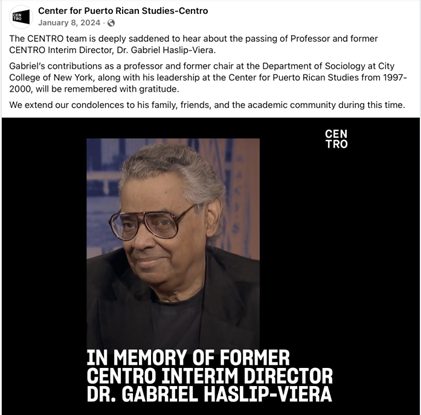
Other speakers highlighted Gabriel’s generosity as a mentor. Journalist and scholar Rosalia Reyes recalled feeling self-conscious about speaking English as a non-native speaker. Gabriel encouraged her, saying, “Don’t be afraid to speak English. You’re a Latina.” For Reyes and many others, this reflected his character: he met people where they were, believed in their potential, and offered support not only for their professional development but also for their broader life goals and commitments. As I reflected on the tributes that followed his passing, I found myself thinking less about institutional recognition and more about the impact he had on the many students, scholars, and independent thinkers whose lives he touched. The Center for Puerto Rican Studies at CENTRO made a post about his passing via Facebook:
When I read about Dr. Haslip-Viera’s passing I was going through a rough patch of my own. I felt guilty that I was so consumed by my own challenges that I never made more of an effort to find out how he was doing. I felt like I should have done more than accept unanswered text messages and facebook messages. A good friend had passed away, and it hurt knowing I never had the chance to say goodbye. Academia can be a cold place, but Gabriel had a way of making people feel welcomed, valued, and cared for. An act that is sometimes hard to receive when you speak your truth and are not fully accepted by certain academic tribes.
My introduction to Dr. Haslip-Viera came under unusual circumstances. I had just published a piece via Latino Rebels titled, “Los estudios sociales y el taíno en Puerto Rico: ¿Y el negro, dónde está?”, (that was taken down by Latino Rebels), which argued that Black culture in Puerto Rico is understood as a less genuine root of the Puerto Rican racial trilogy myth because Africans were imported whereas Native Americans (Tainos) were the original inhabitants on the island, thereby granting Indigenous ancestry a privileged proximity to Puerto Rican identity, a dynamic that can be seen in Puerto Rico’s educational system. One of the most important lessons Gabriel taught me was that scholarship does not begin and end with institutional recognition.
He deeply respected academic rigor and spent much of his life contributing to universities, journals, and scholarly debates. Yet he also understood that intellectual life can flourish outside formal institutions. Some of his most meaningful contributions emerged from his willingness to continue researching, writing, and publishing because he believed certain questions still deserved attention. In an era when visibility and professional status often shape whose voices are heard, Gabriel reminded many of us that curiosity, persistence, and integrity are equally important forms of scholarly practice. Gabriel's commitment to knowledge also extended beyond writing and publishing. He understood the importance of preserving historical memory for future generations. His family photographs and personal materials documenting the early Puerto Rican presence in Brooklyn were deposited with the Center for Puerto Rican Studies archives, ensuring that future researchers would have access to records of Puerto Rican life in New York City. In this respect, Gabriel was not only a scholar of history; he was also one of its caretakers. I believe institutions should do more to preserve his artwork, photographs, and personal writings, including materials he shared publicly over the years.
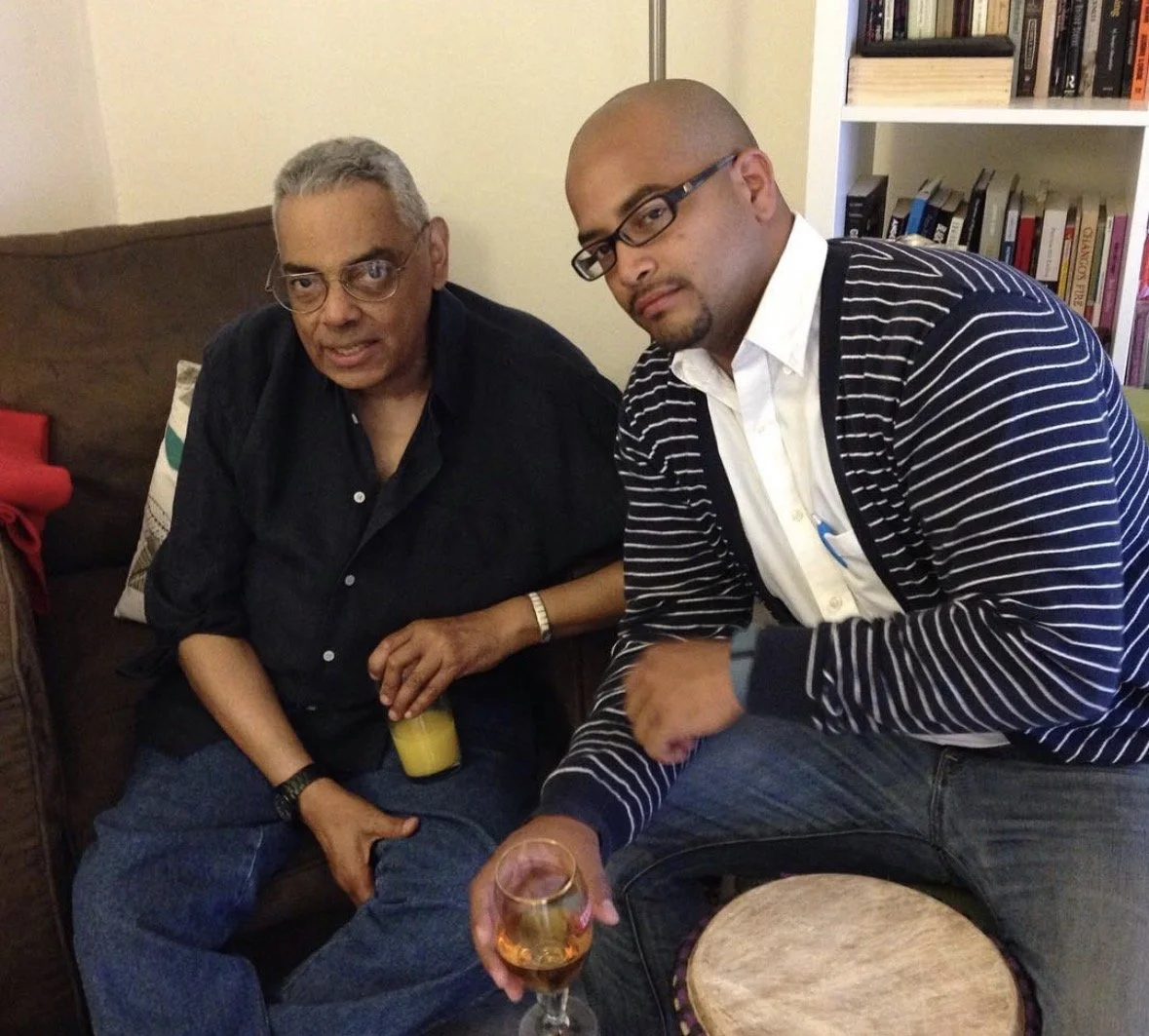
Dr. Gabriel Haslip-Viera and I at my Teachers College, Columbia University dorm, August 6, 2016.
What distinguished Gabriel from many scholars was not simply the positions he took, but his refusal to abandon questions that continued to fascinate him even when they no longer fit prevailing academic interests. Throughout his career he intervened in debates surrounding Neo-Taíno identity, Afrocentric interpretations of pre-Columbian history, racial formation, Hispanophilia, AfroLatino identity, Latino identity, and the politics of heritage. These were not easy subjects. They touched deeply held beliefs about ancestry, nationalism, race, and belonging. Many AfroLatino scholars would think about it twice before pursuing these topics but Gabriel inserted himself without fear of reproach. Yet Gabriel seemed convinced that difficult questions do not disappear simply because they make us uncomfortable. It was great to find out that I wasn't the only one willing to put yourself out there and speak your truth. However, unlike me who tended to not navigate academia and activist circles with ease, he was very efficient at navigating any space and left his mark. I wish I could be like him and give me a goal to strive towards.
Whether readers agreed with his conclusions or not, his work challenged people to defend their claims with evidence and to critically evaluate how identities are constructed, maintained, and mobilized. In this sense, Gabriel occupied a role that has become increasingly rare: that of a scholar willing to stand in the middle of controversy and insist that intellectual debate remains necessary. I once asked a tenure professor at Rutgers why most scholars don’t mention topics that were hypocritical in academia, they responded by saying because they did not want to affect their job security and prospects. This is where Gabriel was different. When I mentioned to a renowned academic that Gabriel was still doing his work on neo-tainos, they responded by saying, “is he still doing that work?”
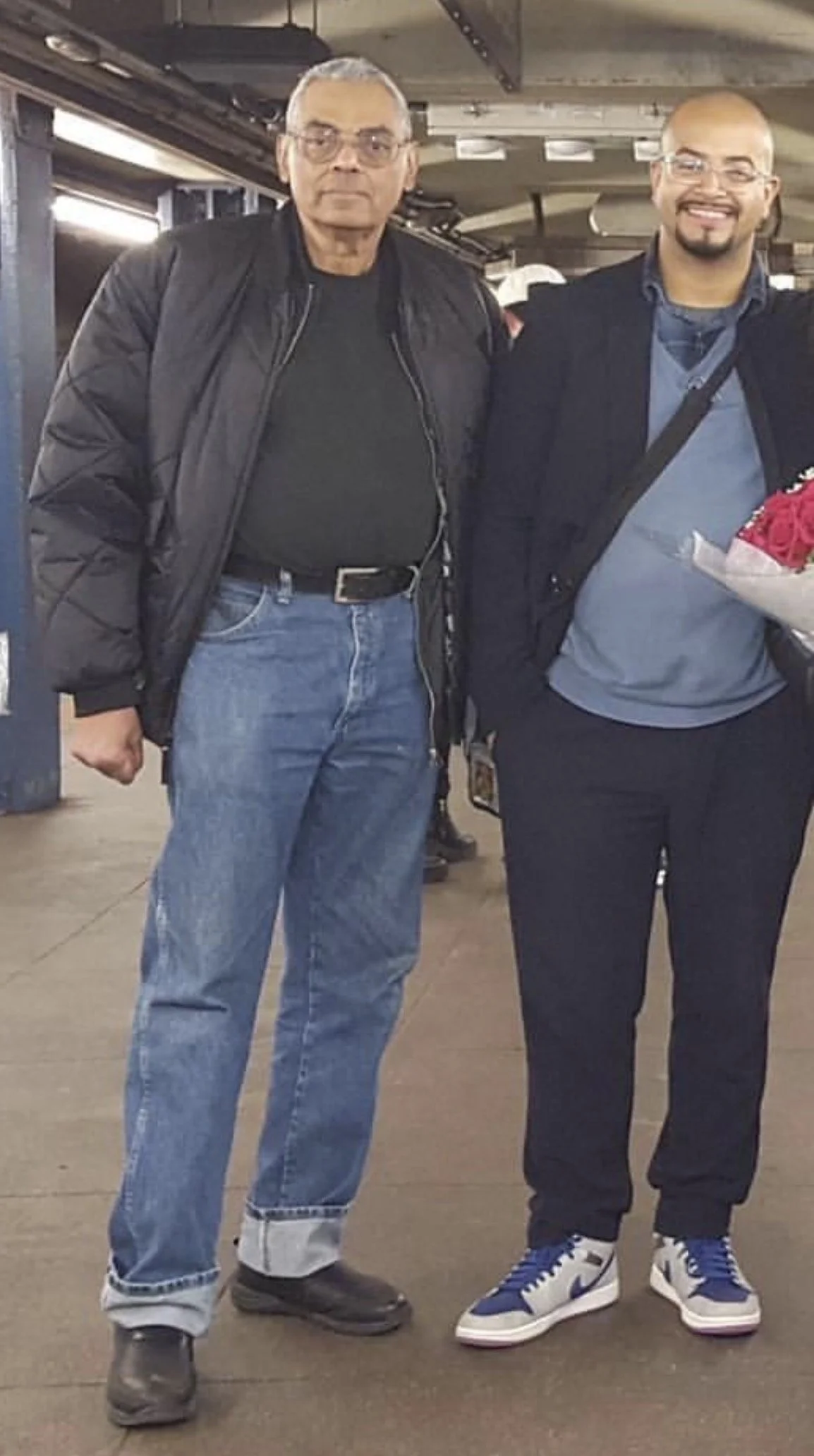
In this image, we were returning from a non-academic panel discussion that was unexpectedly taken over by members of the audience, regardless of the panel’s focus on Blackness and Afrolatinidad.
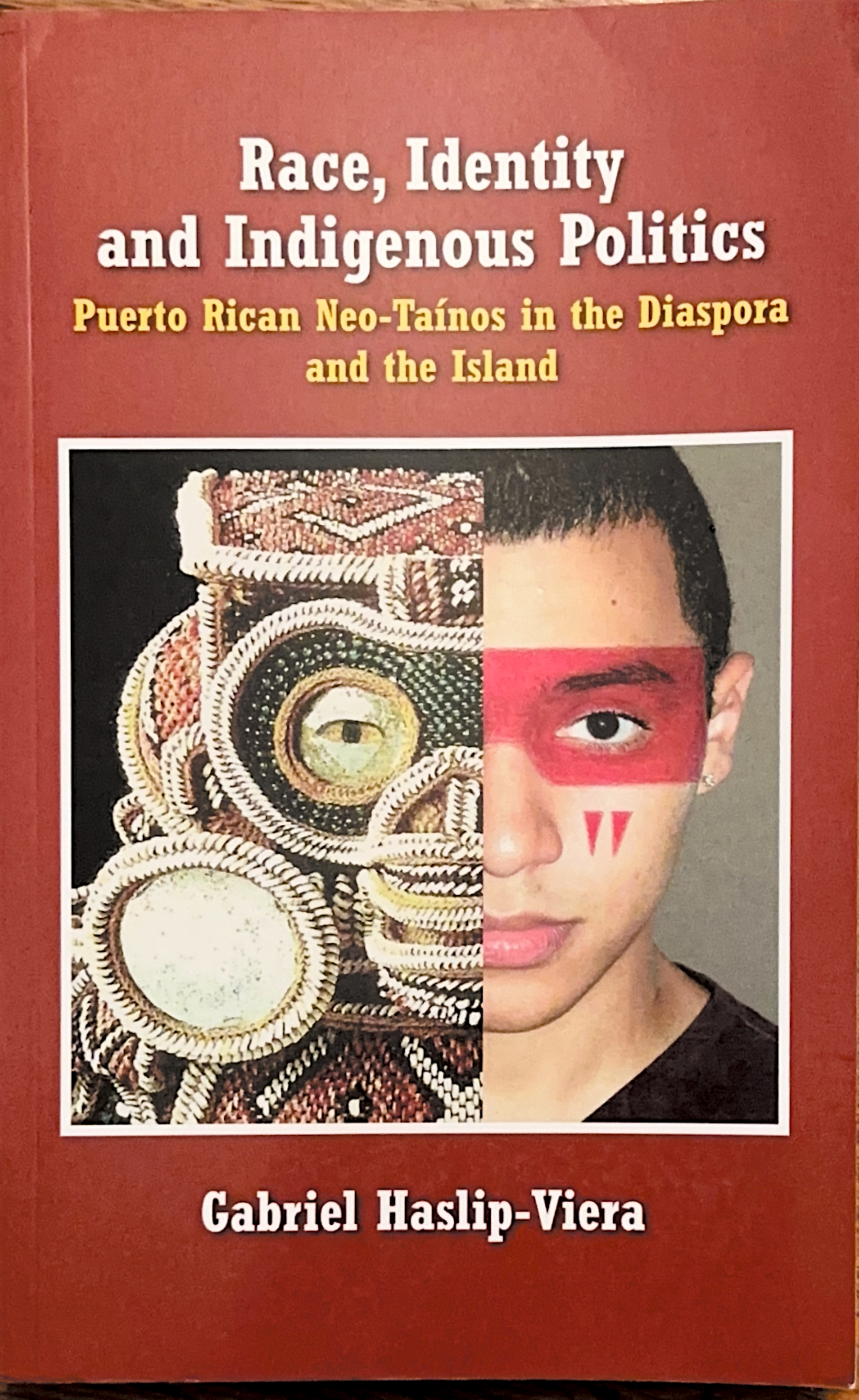
By the time many academics achieve emeritus status, they often spend their remaining years revisiting familiar work or reflecting on past accomplishments. Gabriel seemed to move in the opposite direction. Rather than retreat from debate, he continued pursuing new lines of inquiry. His later publications—including Race, Identity and Indigenous Politics: Puerto Rican Neo-Taínos in the Diaspora and Thieves of Civilization—demonstrated his willingness to continue researching and publishing despite knowing that some readers would strongly disagree with him. There is something admirable about that commitment. These were not books written to gain popularity. They were books written because Gabriel believed the questions were worth asking. Although many readers associate Gabriel with his interventions regarding Neo-Taíno identity and the politics of indigeneity, his intellectual interests were far broader. His scholarship ranged from colonial Mexican history to Puerto Rican migration, race, identity formation, and the historical development of Latino communities in New York City. Works such as Boricuas in Gotham and Latinos in New York reflected his enduring commitment to documenting and understanding the historical experiences of Puerto Rican and Latino communities both on the island and in the diaspora. His intellectual curiosity refused to be confined to a single debate or disciplinary boundary.
As you get older you start to reflect on your writing and publication more critically. Questions such as: Should I have written and published this particular piece? Should I have written it a little differently? Perhaps I wouldn't have burned so many bridges? Perhaps I'd get invited to publish other works of literature amongst other scholars and educators? When we are younger, it is easy to believe that conviction alone is enough. With age, however, many writers begin to reflect more carefully on the costs and consequences of taking unpopular positions. Interrupting the status quo seems satisfying until you're over the age of 40 and you barely get a greeting during conferences. Gabriel often challenged prevailing assumptions within Latino and Puerto Rican Studies. Whether the topic was race, indigeneity, nationalism, or cultural identity, he encouraged critical discussion of issues that many scholars approached cautiously. He possessed an intellectual curiosity that did not depend on academic trends or professional rewards. His conviction for truth beyond academia is where we connected.
One of his most interesting publications was the book titled White Latino Privilege: Caribbean Latino Perspectives in the Second Decade of the 21st Century (2018), is a collection of essays that examines how racial privilege operates within Latino communities, particularly among Caribbean Latinos in the United States and Latin America. The contributors are largely younger Latino scholars and writers who identify as non-white or Black and reflect on their lived experiences. I was lucky enough to be able to add some of my reflections regarding white Latinidad and I remain grateful for his efforts to to include me in his approach towards knowledge production. The book argues that many discussions about Latinos in the United States treat Latinos as a single racial group, when in reality there are significant racial hierarchies within Latino communities. The authors contend that lighter-skinned or white-identifying Latinos often receive social, economic, cultural, and political advantages that are not available to Afro-Latinos and darker-skinned Latinos.
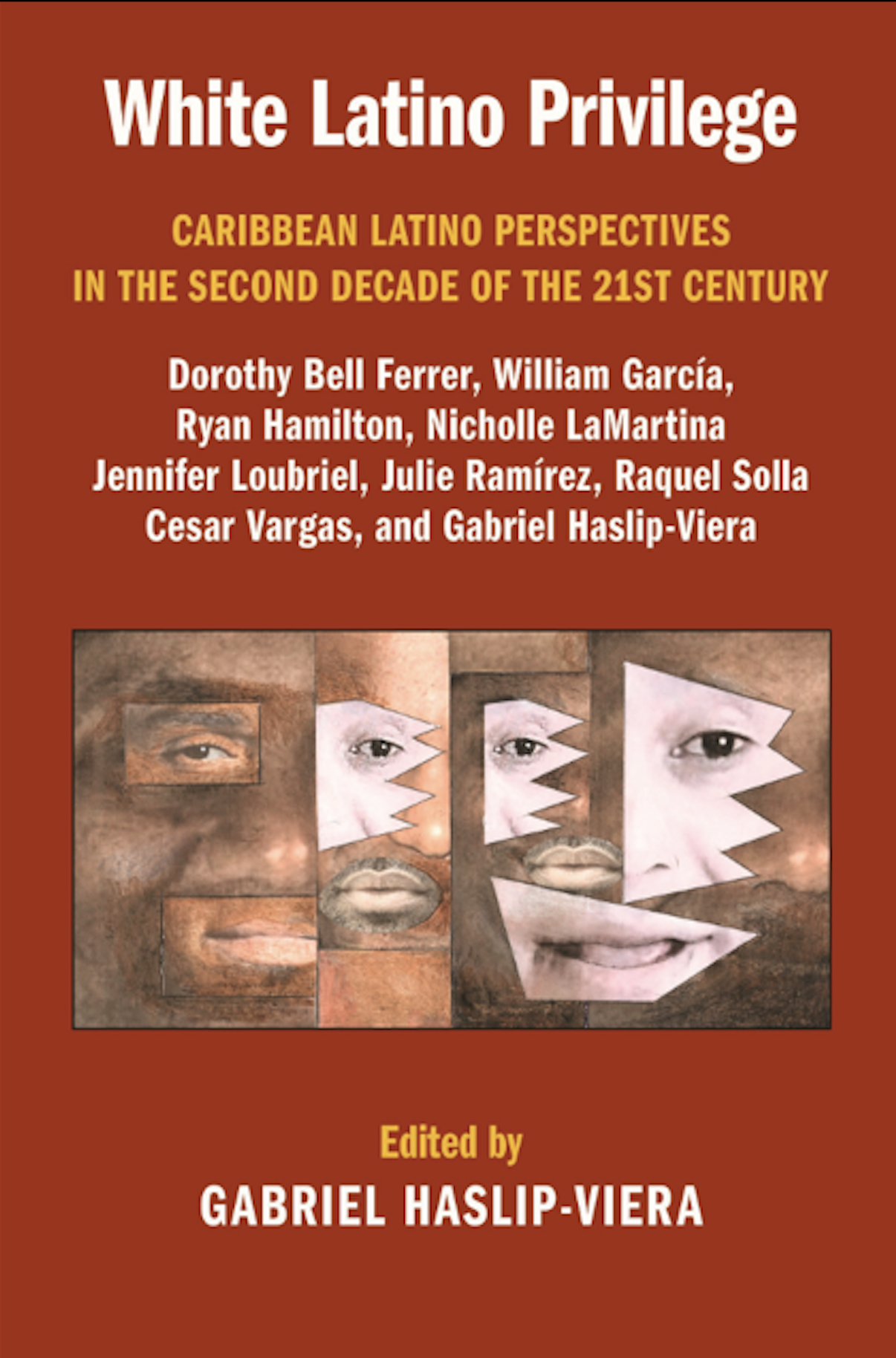
I found it particularly noteworthy that a scholar of Gabriel's stature chose to support a project like White Latino Privilege. The volume brought together writers from diverse academic and personal backgrounds to explore racial hierarchies within Latino communities. Regardless of where one stood on particular arguments, the project reflected a quality that defined Gabriel throughout his career: a willingness to engage conversations that remained underdeveloped or uncomfortable within both academic and community settings. That is what set Dr. Haslip-Viera apart, he wasn't just interested in publishing peer reviewed articles and books. That is not to say that publishing through this means is not important. Getting a peer reviewed article published can echo for an eternity and will live long after the writer passes away. However, as mentioned above, he had an actual love for the truth and critical dialogues to increase community work by pushing back against hyper nationalistic ideas of what it means to be Puerto Rican, Afrolatino or Black. He was aware that it was suspicious that you were a Black Latino but not a white Latino. You could be “white passing”, “white appearing” or "visibly white” but not be a white Latino.
He recognized the contradictions that can emerge when individuals reject a white identity while continuing to benefit from the social advantages associated with whiteness. He didn't think that White Latinidad was the end of the conversation. Rather, he was interested in the aspect of debate that would bring about justice and consideration for how we occupy space in academic and society at large.
This willingness to cultivate dialogue rather than simply defend his own position was an important part of his praxis. He was not particularly concerned with a writer’s prestige, institutional affiliation, or professional network. Instead, he was interested in creating space for voices and perspectives that were often overlooked. Similar to Neo-Tainos, Afrocentricity and Hispanophilia, White Latinidad was another topic Dr. Haslip-Viera believed deserved more attention within the academy and Latino communities at large. Regarding Puerto Rican identity in the diaspora, Haslip-Viera observed, “In the Diaspora, the were the writings and positions taken by the mostly young radicals in their mainland political organizations that defined Puerto Ricans as a non hierarchical “rainbow people” with criticism of the racism that existed in the island and among mainland Puerto Ricans”(pp.51). He critiqued activist circles who kept saying, “we come in different colors” while ignoring racial hierarchies in Puerto Rico and Latino communities in the United States. I have spent years advocating for a more honest discussion of white supremacy, colorism, and anti-Black racism within Latino communities, arguing that racial justice requires acknowledging the advantages that white Latinos can possess. I still think about how important being a white Latino is when you have ICE raids racially profiling mestizo and Black Latinos. Being a white Latino can be the difference between life and death in the United States. It felt good to know that I was not the only one to believe that Latino identity does not eliminate racial privilege and white Latinos often benefit from whiteness while Afro-Latinos experience marginalization. The idea that this critical dialogue is essential for understanding inequality within Latino communities was supported by Dr. Haslip Viera.
Conclusion
In the end, I do not think Gabriel measured the value of a life by the number of awards received, buildings named in one's honor, or institutional tributes left behind. Those recognitions may matter, but they are not what made him memorable. What made Gabriel memorable was his commitment to ideas, his willingness to engage difficult questions, and his openness toward younger scholars, independent researchers, writers, and activists who were often overlooked by more traditional academic circles. He understood that meaningful conversations can emerge from unexpected places and that good ideas are not limited to those with the most prestigious titles. He met with people in restaurants, their homes and nontraditional academic settings.
For me, Gabriel's legacy is not simply a body of scholarship. It is a model of intellectual independence. He demonstrated that it is possible to pursue difficult questions without waiting for permission, to engage in debate without abandoning integrity, and to continue learning regardless of one's professional status. His life reminds us that scholarship is not merely a career. It is a practice. It is a commitment to asking questions, following evidence, mentoring others, and remaining open to dialogue even when disagreement exists.
If we want to honor Gabriel Haslip-Viera, we should do more than remember his books and articles. We should emulate the qualities that defined him: intellectual courage, curiosity, generosity toward younger generations, and a genuine love of knowledge both inside and outside the academy. He was loved by a lot of people.
The term Carl Jung uses for becoming a distinct, realized individual while still remaining fully connected to people and society is individuation. In Memories, Dreams and Reflections, Jung describes it as the lifelong process of integrating the conscious and unconscious mind to achieve psychological wholeness. In his view, individuation does not mean isolating yourself. Instead, it balances discovering your unique, authentic self with maintaining meaningful, ethical relationships with others and your community. This definition by Jung aptly describes Dr. Haslip-Viera. As the years pass, I hope his name remains firmly within the history of Puerto Rican, Caribbean, and Latino Studies. More importantly, I hope the example he set continues to inspire those who believe that scholarship should be driven not only by recognition, but by conviction.
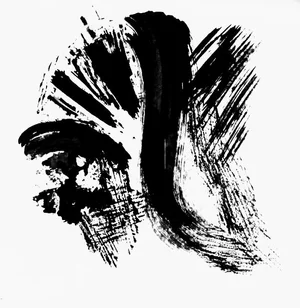
If there is a lesson to be drawn from Gabriel's life, it is that intellectual life should not be confined by institutional boundaries. Scholarships can take place in classrooms, archives, community centers, bookstores, and conversations between friends. Gabriel understood this better than most. He moved comfortably between the academy and the broader public sphere, bringing the same curiosity and commitment to each. Even his artistic pursuits reflected that same spirit of curiosity and exploration!
As future generations wrestle with questions of race, identity, nationhood, and belonging, I hope they continue to engage in his work—not because they must agree with all of his conclusions, but because he demonstrated the importance of thinking critically, questioning assumptions, and pursuing knowledge with integrity. In that sense, Gabriel Haslip-Viera left behind more than books and articles. He left behind an example. I am still processing his passing, but I continue to reflect on the way he lived—with love, a sense of community, and a deep commitment to intellectual rigor. Although I regret some of my own approaches to truth seeking, his legacy reminds me that my own search for truth is nothing to regret.
As the singer Bobby Cruz once said, "Yo sí viví y siempre fui a mi manera"—I truly lived, and I always did it my way. In many respects, that sentiment captures Gabriel perfectly. He pursued scholarship on his own terms, remained committed to the questions that mattered to him, and left behind a body of work that invites us to think more critically about identity, history, and ourselves.
That is a legacy worth remembering.
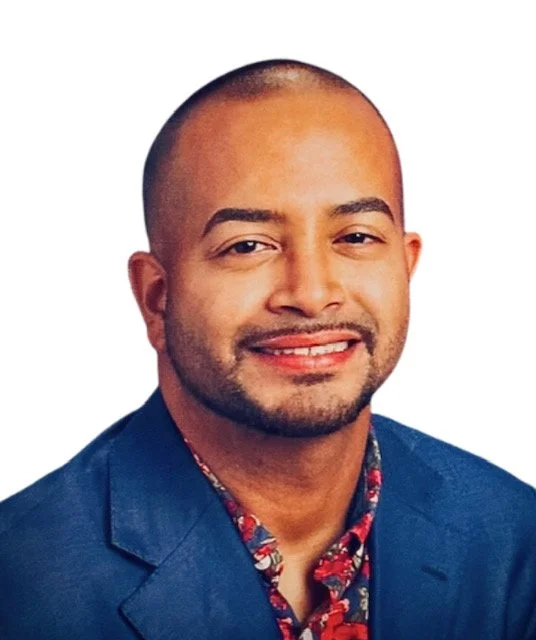
Dr. William García-Medina is an Assistant Professor of History at the University of Cincinnati-
Blue Ash College. He holds a Ph.D. in American Studies and a certificate in Museum Studies.
His scholarship centers on Black diasporic public humanities, Afro-Latinx education, cultural
studies, and the ways Black communities shape and sustain public history and cultural memory.
Beyond academia, he contributes to public scholarship by facilitating workshops, consulting, and
community-engaged programming for educational and cultural institutions.